
Raw Channel RF Data and Programmable Ultrasound Acquisition
ArtUs USS-2H research ultrasound platform
ArtUs USS-2H provides researchers with access to raw RF data from up to 64 individual receive channels, beamformed RF data at several signal-processing stages, and programmable control of ultrasound acquisition through the TELEMED SDK.
ArtUs RF Data Control II is a C++ SDK sample and reference implementation with GUI and source code. It demonstrates the SDK interfaces used for channel-data acquisition and programmable ultrasound control, and can also be used directly when its functionality is sufficient for the experiment.
ArtUs USS-2H provides researchers with access to raw RF data from up to 64 individual receive channels, beamformed RF data at several signal-processing stages, and programmable control of ultrasound acquisition through the TELEMED SDK.
ArtUs RF Data Control II is a C++ SDK sample and reference implementation with GUI and source code. It demonstrates the SDK interfaces used for channel-data acquisition and programmable ultrasound control, and can also be used directly when its functionality is sufficient for the experiment.

Artus USS-2H ultrasound scanner
Core Research Capabilities
64 TX/RX
channel RF data
4 source points
beam formed RF / I+Q
Programmable TX/RX
delays, pulses, apertures
C++ SDK
sample + source code
What the researcher can control
In addition to acquiring raw data, ArtUs USS-2H exposes acquisition controls that allow experiments beyond conventional focused B-mode scanning.
In addition to acquiring raw data, ArtUs USS-2H exposes acquisition controls that allow experiments beyond conventional focused B-mode scanning.
- Program custom transmit delay values for individual channels and apertures.
- Select active channels from the 64 available receive channels.
- Program custom tri-state transmit excitation pulses (+A, 0, -A).
- Select arbitrary beams / working apertures and define custom acquisition sequences.
- Adjust analog front-end parameters and custom depth-dependent analog amplification.
- Use documented configurations for plane-wave scanning, plane-wave compound scanning and passive reception.
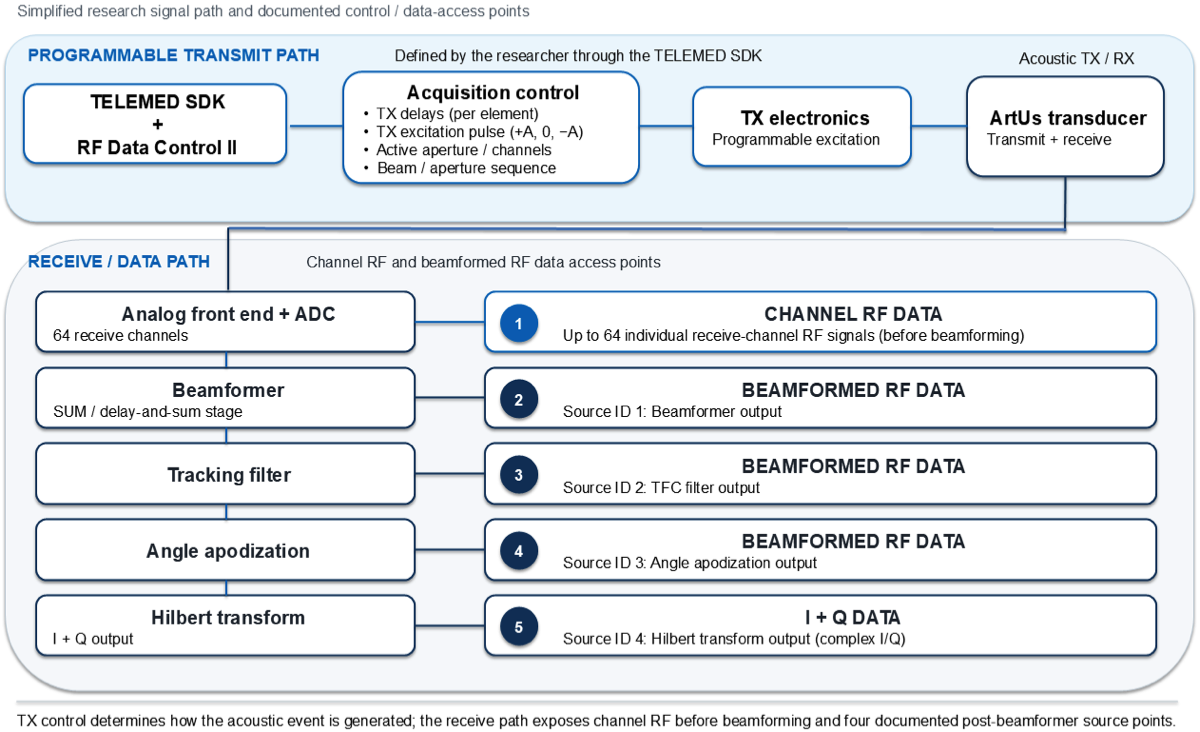
RF data available for researcher
Data
Access point
Purpose / note
Channel RF data
Before receive beamforming
Individual signals from up to 64 active receive channels.
Beamformer RF data
Source ID 1 — Beamformer output
RF immediately after the receive beamformer / summation stage.
Beamformed RF data
Source ID 2 — TFC filter output
Beamformed RF after TFC filtering.
Beamformer RF data
Source ID 3 — Angle apozidation output
Beamformed RF after the angle-apozidation stage.
I + Q data
Source ID 4 — Hilbert transform output
Complex I/Q representation after the Hilbert-transform stage.
Programmable ultrasound acquisition
Access to channel data is only one part of the research platform. ArtUs USS-2H also allows researchers to control how the data are acquired. The corresponding TELEMED SDK interfaces are demonstrated in the ArtUs RF Data Control II sample.
Plane-wave acquisition
ArtUs USS-2H can be configured for plane-wave scanning by programming identical non-zero transmit delays across the active 64-channel aperture. Transmit delays can also be varied to create steered plane waves. The RF Data Control II documentation includes plane-wave compound scanning with multiple delay sets, including the example sequence 0°, −2°, +2°, −4° and +4°.
For probes containing more elements than the 64-channel electronic aperture, arbitrary beam selection can be used to choose different aperture positions. The number of selected apertures and their overlap can be chosen according to the required coverage and acquisition rate.
Passive acoustic acquisition
ArtUs USS-2H can also operate in a receive-only configuration. In the documented passive-receive scenario, every transmit-delay value is set to zero, muting ultrasound transmission while the receive channels remain available for acquisition.
This makes the platform useful for experiments in which the acoustic signal is generated by an external source rather than by the scanner. Potential research applications include photoacoustic / optoacoustic acquisition, passive cavitation detection and mapping, and monitoring of therapeutic ultrasound or HIFU experiments. These are research use cases, not turnkey TELEMED imaging modes.
Why the combination matters
The research value of USS-2H is the combination of programmable transmit / receive acquisition and access to individual channel signals. Researchers can therefore define the acquisition sequence in the scanner and perform their own beamforming, localization, filtering or reconstruction offline or in custom software.
Plane-wave acquisition
ArtUs USS-2H can be configured for plane-wave scanning by programming identical non-zero transmit delays across the active 64-channel aperture. Transmit delays can also be varied to create steered plane waves. The RF Data Control II documentation includes plane-wave compound scanning with multiple delay sets, including the example sequence 0°, −2°, +2°, −4° and +4°.
For probes containing more elements than the 64-channel electronic aperture, arbitrary beam selection can be used to choose different aperture positions. The number of selected apertures and their overlap can be chosen according to the required coverage and acquisition rate.
Passive acoustic acquisition
ArtUs USS-2H can also operate in a receive-only configuration. In the documented passive-receive scenario, every transmit-delay value is set to zero, muting ultrasound transmission while the receive channels remain available for acquisition.
This makes the platform useful for experiments in which the acoustic signal is generated by an external source rather than by the scanner. Potential research applications include photoacoustic / optoacoustic acquisition, passive cavitation detection and mapping, and monitoring of therapeutic ultrasound or HIFU experiments. These are research use cases, not turnkey TELEMED imaging modes.
Why the combination matters
The research value of USS-2H is the combination of programmable transmit / receive acquisition and access to individual channel signals. Researchers can therefore define the acquisition sequence in the scanner and perform their own beamforming, localization, filtering or reconstruction offline or in custom software.
Acquisition control
Research scenarios
- TX delays
- TX excitation pulse
- Active RX channels
- Arbitrary beams / apertures
- AFE / depth-dependent analog gain
- Custom focused / unfocused transmission
- Plane-wave and steered plane-wave acquisition
- Plane-wave compound sequences
- Passive receive-only acquisition
- Custom beamforming / reconstruction
ArtUs RF Data Control II and TELEMED SDK
A C++ SDK sample, not a closed software product
ArtUs RF Data Control II is a C++ SDK sample and reference implementation demonstrating how TELEMED SDK interfaces can be used for channel RF data acquisition and programmable ultrasound control.
The sample includes a graphical user interface and source code. For many experiments it can be used directly. Researchers who need a specialized workflow can use the same SDK interfaces and the supplied source as a reference for their own software.
ArtUs RF Data Control II is a C++ SDK sample and reference implementation demonstrating how TELEMED SDK interfaces can be used for channel RF data acquisition and programmable ultrasound control.
The sample includes a graphical user interface and source code. For many experiments it can be used directly. Researchers who need a specialized workflow can use the same SDK interfaces and the supplied source as a reference for their own software.

ArtUs RF Data Control II GUI
Suggested download / navigation links
Final words
ArtUs USS-2H combines a programmable 64-channel ultrasound front end, control of transmit delays, excitation pulses and acquisition sequences, access to raw channel RF data, selectable beamformed RF data source points and SDK-level control of the acquisition process. Researchers can start with the supplied RF Data Control II sample and source code, or build a fully customized acquisition and reconstruction workflow using the TELEMED SDK.